
The Real Talent Shortage Isn’t About Supply — It’s About Imagination
Are your hiring strategies keeping up?
Every headline says the same thing: there’s a talent shortage. But a closer look tells a more nuanced story.
The Wall Street Journal recently noted that even in a sea of tech talent, with layoffs, retraining programs, and career switchers flooding the market, many companies still can’t find the workers they want. The problem isn’t just about supply. It’s about how narrowly we define “qualified.”
We’re living in a moment when technology, sustainability, and innovation are reshaping nearly every industry. Yet many hiring systems remain anchored in outdated checklists, rigid credential filters, and narrow definitions of success.
The most successful organizations aren’t waiting for unicorn candidates to appear. They are widening their aperture, using imagination, data, and empathy to redefine what great talent looks like.
Here’s what that looks like in practice.
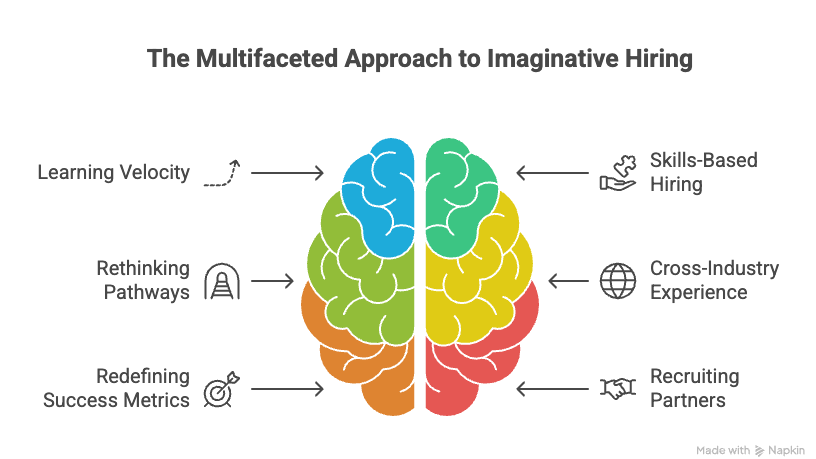
Hire for Learning Velocity, Not Static Skills
In a market where technology cycles reset every 18 months, yesterday’s skills can’t predict tomorrow’s success. What does? The ability to learn.
Learning agility—curiosity, adaptability, and resilience in the face of change—has become the single most reliable predictor of future performance.
McKinsey reports that 87% of companies already face or expect a skills gap within the next few years. That means the “perfect skill match” is a moving target.
BCG’s research reinforces this: companies that prioritize growth mindset and adaptability in hiring report stronger innovation outcomes and faster time to productivity among new hires.¹
Imaginative hiring leaders don’t just ask, “Have you done this before?” They ask, “Can you learn faster than the world is changing

Embrace Skills-Based Hiring, But Don’t Stop There
Skills-based hiring is one of the most practical ways to open the talent funnel, but it works best when used creatively.
According to SHRM, skills-based approaches widen the talent pool and improve the accuracy of job success predictions.² Employers that embrace this approach are 60% more likely to make successful hires and see longer retention rates, according to LinkedIn and TestGorilla data.
Even so, skills-based hiring can become another box to check if applied rigidly. The goal isn’t to replace degree filters with skills filters. It’s to focus on capability, potential, and adjacent-fit experience.
Think of the engineer moving from robotics to solar, or the logistics leader transitioning into EV supply chains. The contexts differ, but the core competencies—problem-solving, systems thinking, and operational execution—translate powerfully.
Build the Bridge: Rethink Pathways and On-Ramps
If the talent you need doesn’t exist yet, build the bridge to get there.

Forward-thinking companies are creating apprenticeships, returnships, and rotational programs to bring in nontraditional candidates and help them ramp faster.
- Mathematica calls apprenticeships “a powerful mechanism to address skills gaps and create new career pathways.”³
- McKinsey highlights that hands-on apprenticeship learning can scale development faster and more sustainably than classroom training.⁴
- And according to Seramount, over 80% of returnship participants across six major programs were offered full-time employment—tangible proof that alternate pathways work.⁵
This is what imagination looks like operationalized: turning “we can’t find them” into “we can grow them.”
Value Cross-Industry and Transferable Experience
Innovation doesn’t come from hiring the same profile again and again. It comes from cross-pollination.
Cross-industry hiring doesn’t dilute expertise; it multiplies perspective. The most imaginative organizations see beyond titles and recognize that capability often transcends category.

Why can’t an energy-efficiency engineer excel as an energy load analyst? Both rely on interpreting data to optimize performance, reduce waste, and drive smarter energy use. The context changes, but the analytical mindset remains constant.
Why shouldn’t a solar sales leader thrive in battery storage? Both require technical fluency, consultative selling, and the ability to translate value across the grid edge. The same customer empathy, relationship skills, and market insight that drive solar success apply directly to storage and often spark new thinking about system integration and total energy value.
When companies look across disciplines rather than within silos, they don’t just fill roles. They import innovation.
These hires bring fresh mental models, broader cultural range, and creative problem-solving that homogeneous teams may never surface. They challenge legacy assumptions and introduce new analogies that help teams see old problems in new ways.
Redefine Success Metrics and Evaluation Methods
If your hiring process only measures what’s been done, you’ll keep hiring the past.
Leading companies are replacing traditional interviews with skills trials, scenario simulations, and problem-solving exercises that reveal how candidates think, not just what they’ve done.
BCG reports that skills-based hires are five times more likely to predict job performance than hires based solely on credentials.¹ That’s a powerful argument for moving away from résumé-driven screening.
This approach uncovers hidden gems—the candidates who may lack a “perfect” title but have demonstrated the ability to diagnose problems, learn fast, and build solutions collaboratively.

Why Recruiting Partners Are the Bridge Builders
The companies that embrace imagination in hiring rarely do it alone.
Recruiting and staffing firms with deep domain expertise are uniquely positioned to bridge industries and uncover talent others overlook. They sit at the intersection of markets, roles, and career transitions, seeing firsthand how a product leader from semiconductors can thrive in renewables or how an energy-efficiency specialist can drive impact in smart grid analytics.
Because recruiters understand the transferable DNA of success—the blend of skills, behaviors, and motivations that travel well across industries—they help clients see beyond the résumé and toward the potential.
A strategic recruiting partner brings:
- Market perspective: Access to real-time data on where talent is moving and how skills are converging.
- Contextual matching: The ability to evaluate not just experience but relevance and adaptability within new settings.
- Human insight: Conversations, references, and relationships that reveal how a candidate solves problems, not just what’s on paper.

In short, they provide the imagination infrastructure that helps organizations widen their aperture, reframe assumptions, and find the Impact Players who can grow with them.
The Case for Imagination
When hiring managers say, “We can’t find good people,” it often really means, “We can’t recognize them.”
Imagination in hiring is about curiosity—the willingness to see potential where others see gaps, to connect adjacent skills to emerging needs, and to invest in capability that grows with your business.
It’s about creating a culture that values adaptability, not perfection.
Curiosity, not conformity.
Potential, not pedigree.
The companies that succeed won’t be those with the most rigid processes. They’ll be the ones with the courage to look differently at talent.
Because the future isn’t built by those who hire for what is.
It’s built by those who hire for what could be.
For more insights, you can find the references below used for this article:
- Boston Consulting Group – Competence Over Credentials: The Rise of Skills-Based Hiring (2023)
- SHRM – Transforming HR: The Rise of Skills-Based Hiring and Retention Strategies (2024)
- Mathematica – The Power of Apprenticeships in a Changing Labor Market (2023)
- McKinsey – Reviving the Art of Apprenticeship to Unlock Continuous Skill Development (2024)
- Seramount – Returnships, Apprenticeships & Sabbaticals: Re-Entry Programs that Work (2023)