
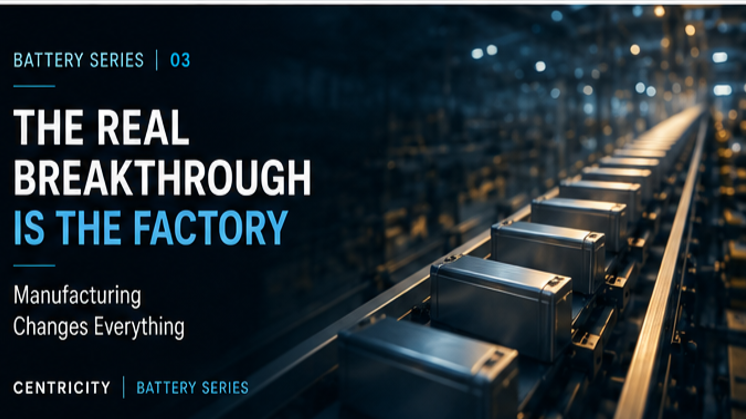
The Next Battery Breakthrough May Be on the Factory Floor
The battery industry spends a great deal of time discussing chemistry.
New cathodes. New anodes. New electrolytes.
Those advancements matter.
But as battery production scales globally, a different reality is emerging.
Execution is becoming the constraint.
According to the International Energy Agency’s Global Energy Review, battery storage deployments continue to grow at more than 40% annually. That level of expansion is not limited by innovation alone. It is increasingly limited by the ability to manufacture at scale.
McKinsey’s analysis of battery manufacturing reinforces the same point: the industry’s next phase will be defined by production efficiency, yield and supply-chain execution—not just chemistry breakthroughs.
That aligns closely with what we hear from operations leaders and CTOs.
The science is advancing.
The factory is becoming the differentiator.
Scale changes everything
A defect that is manageable in a pilot environment becomes expensive—and potentially dangerous—at scale.
That includes:
- Yield loss
- Scrap and rework
- Thermal events
- Warranty exposure
- Customer trust
When we walk a client’s factory floor, the most important discussions are rarely about theoretical performance.
They are about consistency.
- Are welds repeatable?
- Are defects detectable early?
- Is process data connected?
- Is variation understood or hidden?
These are not chemistry problems.
They are manufacturing problems.
Battery manufacturing is now a convergence industry
Battery production now sits at the intersection of:
- Advanced materials
- Automation and robotics
- Machine vision
- Laser welding and joining
- Nondestructive testing
- Industrial data systems
- Artificial intelligence
Organizations like NIST’s advanced manufacturing program and DOE Manufacturing USA have emphasized that next-generation manufacturing depends on integrating these disciplines—not optimizing them in isolation.
That is exactly what we are seeing in hiring.
Battery companies are no longer competing only with each other.
They are competing with:
- Semiconductor manufacturers
- Aerospace and defense
- Medical device companies
- Industrial automation firms
The best talent often isn’t in batteries yet.
Quality is moving upstream
Traditional quality models focus on inspection.
That is no longer sufficient.
Modern battery manufacturing requires quality to be designed into:
- Product architecture
- Process development
- Equipment selection
- Supplier qualification
- Data systems
According to NIST and advanced manufacturing research, embedding quality early in the process is one of the most effective ways to reduce defects and improve scalability.
Our clients are moving in that direction.
They are hiring quality leaders earlier—and expecting them to influence engineering decisions, not just validate outcomes.
Data is becoming the real differentiator
A modern battery factory generates enormous amounts of data:
- Material lots
- Environmental conditions
- Machine settings
- Inspection results
- Performance outcomes
Yet many organizations still struggle to connect those data points into a usable system.
That is changing.
As McKinsey notes in its manufacturing analysis, companies that successfully integrate data across production and operations gain a measurable advantage in yield, quality and speed.
This is driving demand for a new type of talent:
People who understand both manufacturing and data.
Not just engineers.
Not just software developers.
But individuals who can connect the two.
What we’re seeing in the talent market
• Battery companies are hiring heavily from semiconductors, automation and precision manufacturing
• Machine vision, inspection and data engineering roles are accelerating rapidly
• Quality leaders are being pulled earlier into product and process design
• Operations leaders are expected to be far more technically fluent
The takeaway
The battery industry often frames innovation as a chemistry race.
But increasingly, it is an execution race.
The companies that lead will not simply be those with the most advanced materials.
They will be the ones that:
- Build manufacturing capability early
- Integrate quality into design—not after production
- Leverage data as a strategic asset
- Recruit talent from adjacent high-precision industries
- Align engineering and operations as one system
Because at scale, the breakthrough is not just what you build.
It is whether you can build it the same way—every time.