
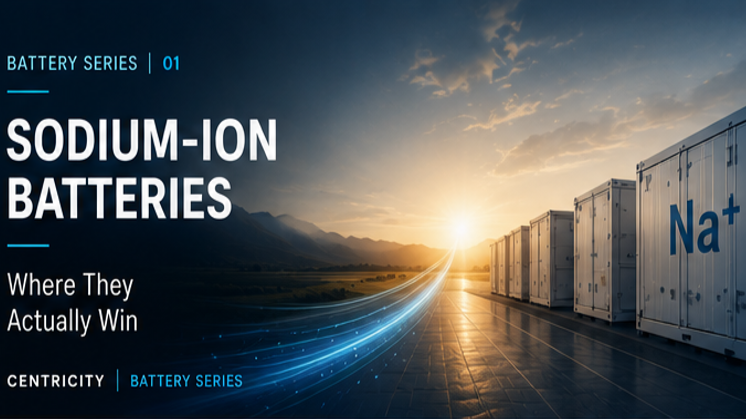
Sodium-Ion Is No Longer a Science Project: Where It Can Win—and Who Will Build It
For years, sodium-ion batteries were discussed as an interesting alternative to lithium-ion.
Lower cost. Abundant materials. Improved safety potential.
But always framed as early-stage.
That framing is changing.
The International Energy Agency recently noted that sodium-ion is moving from research into early commercialization, supported by investments from large manufacturers and growing interest in stationary storage applications.
At the same time, research published in Nature Sustainability reinforces that the chemistry is now progressing beyond laboratory validation toward real-world deployment pathways.
That aligns almost perfectly with what we are hearing from CTOs and engineering leaders.
The conversation is no longer about whether sodium-ion works.
It is about where it belongs—and whether companies are building the teams capable of taking it there.
Sodium-ion doesn’t need to win everywhere
One of the biggest shifts happening in batteries is the realization that there is no single “winning” chemistry.
The IEA Global EV Outlook 2026 makes this clear: sodium-ion is unlikely to replace lithium-ion universally, but is increasingly viable in stationary storage, industrial applications and cost-sensitive mobility segments.
This is reinforced by McKinsey’s work on battery ecosystems, which highlights that the future battery market will be segmented by application, not dominated by a single chemistry.
Our clients are making the same observation.
They are no longer asking, “Can sodium-ion compete with lithium-ion?”
They are asking:
- Where does it create a structural advantage?
- Where does it reduce supply-chain risk?
- Where does it enable a different cost structure?
That shift changes everything—including how companies hire.
The talent challenge is already emerging
Having been part of sourcing electrochemists, battery engineers and commercialization leaders for more than a decade, one pattern is consistent:
Emerging technologies rarely fail because of lack of scientific insight.
They stall because organizations are not built to commercialize them.
Sodium-ion will require teams that combine:
- Electrochemistry and materials science
- Cell design and process development
- Manufacturing scale-up
- Battery systems engineering
- Grid and application knowledge
- Product strategy and commercialization
The strongest candidates we meet are rarely deep in just one of these areas. They sit between them. That is where the market is already tightening.
The hiring market is telling us something important
Our clients tell us the same story repeatedly.
They can find strong scientists.
They struggle to find people who can translate chemistry into product.
This is consistent with broader industry data.
McKinsey estimates that scaling battery manufacturing capacity will require not just capital, but a significant expansion of technical and operational talent across the value chain.
The gap is not just in discovery.
It is in execution.
That includes:
- Engineers who have moved a new chemistry into pilot production
- Leaders who understand where performance tradeoffs matter
- Teams who can align cell design with real-world applications
- Commercial leaders who can position the technology correctly
This is where many sodium-ion efforts will separate.
Broaden the definition of “qualified talent”
There are not enough professionals with deep sodium-ion experience to meet future demand.
The companies that move fastest will expand their aperture.
Strong candidates may come from:
- Lithium-ion and LFP development
- Fuel cells and electrochemical systems
- Advanced materials and coatings
- Grid-scale storage platforms
- Semiconductor and precision manufacturing
The key question is not:
“Have they worked on sodium-ion?”
It is:
“Have they taken something difficult from concept to production?”
What we’re seeing in the talent market
• Demand is shifting from pure electrochemistry toward commercialization leadership
• Companies are recruiting more aggressively from adjacent industries
• Systems engineers who connect chemistry and application remain constrained
• Early hiring around manufacturing and product strategy is accelerating timelines
The takeaway
Sodium-ion is no longer waiting for validation.
It is entering the phase where execution determines success.
The companies that win will not simply be those with the most promising chemistry.
They will be the ones that:
- Understand where sodium-ion actually creates value
- Align product strategy with application realities
- Build teams that connect science, manufacturing and market execution
Because at this stage, the question is no longer:
“Can we build it?”
It is:
“Do we have the people who know what to build—and how to scale it?”