
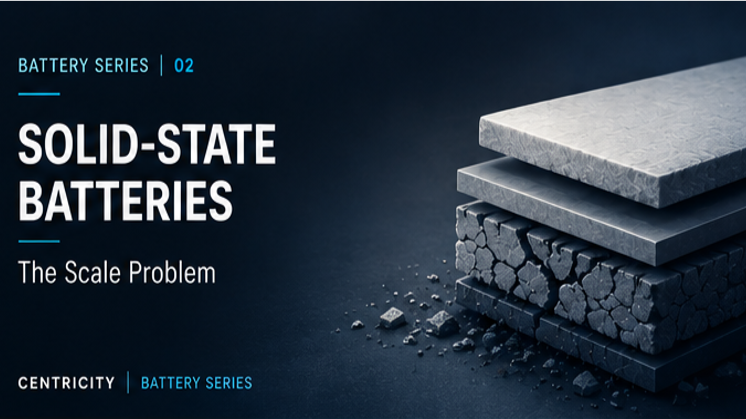
Solid-State Batteries: The Breakthrough Is No Longer Enough
Few technologies in the battery industry have generated more excitement than solid-state batteries.
Higher energy density. Improved safety. Faster charging.
For years, the conversation centered on whether they could work.
Now the question is different.
Can they scale?
The IEA Global EV Outlook 2026 makes this clear: while investment remains high, consistent performance at commercial scale is still unresolved.
Academic research echoes this.
Recent work in Nature Energy highlights that interface stability, manufacturability and long-term reliability remain key barriers to commercialization.
That aligns directly with what CTOs and engineering leaders are telling us.
The science is advancing.
The constraint is execution.
The industry is entering a new phase
Battery development is not linear.
A strong lab result does not automatically translate into a manufacturable product.
According to McKinsey’s battery manufacturing analysis, scaling production remains one of the most complex and capital-intensive challenges in the entire electrification ecosystem.
Our clients describe the same gap:
The organization is deep in science, but thinner in scale-up capability.
That gap becomes critical in solid-state batteries, where performance depends on:
- Material interfaces
- Pressure management
- Manufacturing precision
- Process control
- Equipment capability
- Yield consistency
The talent mix is changing
Solid-state companies still need world-class scientists.
But they also need:
- Process engineers
- Equipment specialists
- Manufacturing leaders
- Quality and reliability engineers
- Systems-level technical leaders
- Program managers with commercialization experience
And these candidates often come from outside the battery industry.
Organizations like Argonne National Laboratory emphasize that battery manufacturing is increasingly aligned with other advanced industries, including semiconductors and precision materials.
We see that play out directly in hiring.
When we walk a client’s factory floor, the most difficult problems are rarely theoretical.
They are practical.
Cross-functional leadership is the bottleneck
Solid-state battery challenges do not remain in one discipline.
A materials decision affects mechanical design.
Mechanical design affects manufacturing.
Manufacturing affects cost.
Cost affects commercialization.
The leaders who can connect those dots are rare—and increasingly valuable.
Our clients consistently identify this type of talent as one of the hardest to find.
They are not just experts.
They are translators between functions.
Interview for scale, not just knowledge
One of the most important hiring shifts is how candidates are evaluated.
Leading companies are moving beyond academic achievement and asking:
- What changed between lab and production?
- Where did yield fail?
- How was the process stabilized?
- What tradeoffs were required?
These questions reveal whether a candidate understands execution.
Because in this phase, execution matters more than theory.
What we’re seeing in the talent market
• Process and manufacturing engineers are becoming as critical as scientists
• Companies are hiring from semiconductors, ceramics and advanced manufacturing
• Cross-functional leaders remain among the most constrained roles
• Scale-up experience is commanding a premium
The takeaway
Solid-state batteries are not a science problem anymore.
They are an execution problem.
The companies that lead will not simply be those with the best performance metrics in controlled environments.
They will be the ones that:
- Build manufacturing discipline early
- Hire process and systems talent alongside research teams
- Bring in leaders who have scaled complex technologies before
- Align technical milestones with commercial reality
Because the breakthrough is no longer enough.
The real advantage belongs to the teams that know how to scale it.