When a Boom Means Progress: What the UK’s Coal Demolition Says About U.S. Energy Strategy
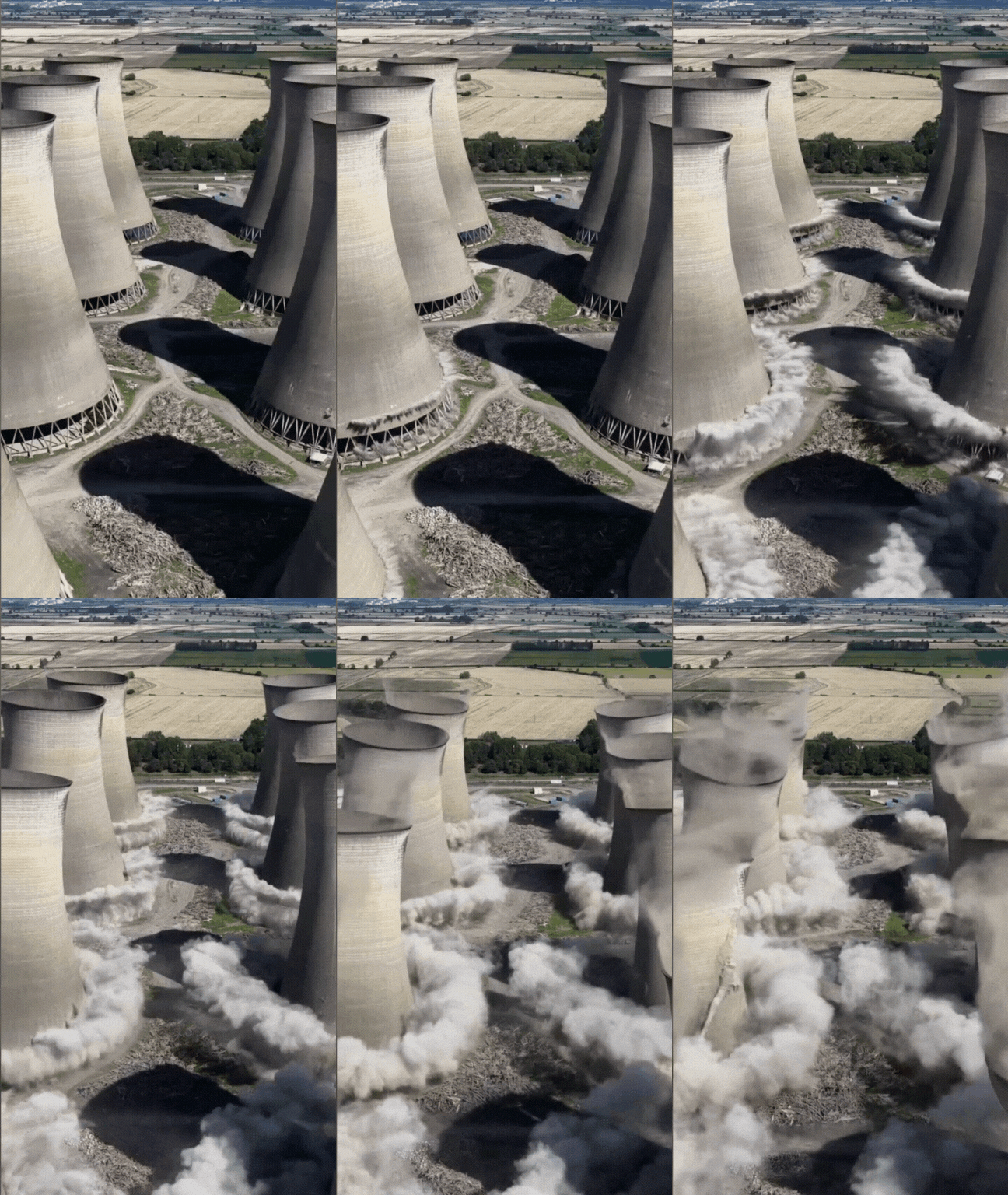
On August 14, 2025, eight giant cooling towers at the former Cottam coal plant in Nottinghamshire dropped in one coordinated blast. It set an official Guinness World Record for the most cooling towers demolished at once and cleared another landmark of the UK’s coal era.
That boom wasn’t just loud. It was clarifying. Britain is wrapping up a 142-year coal story. The country’s last operational coal station, Ratcliffe-on-Soar, closed in September 2024.
Meanwhile, the U.S. is flirting with a short-term uptick in coal’s power mix just as electricity demand hits record highs. The EIA expects U.S. coal’s share to rise to 17% in 2025 before slipping back to 15% in 2026, while overall power consumption sets new records. That is the opposite direction of the UK’s trend.
The scoreboard
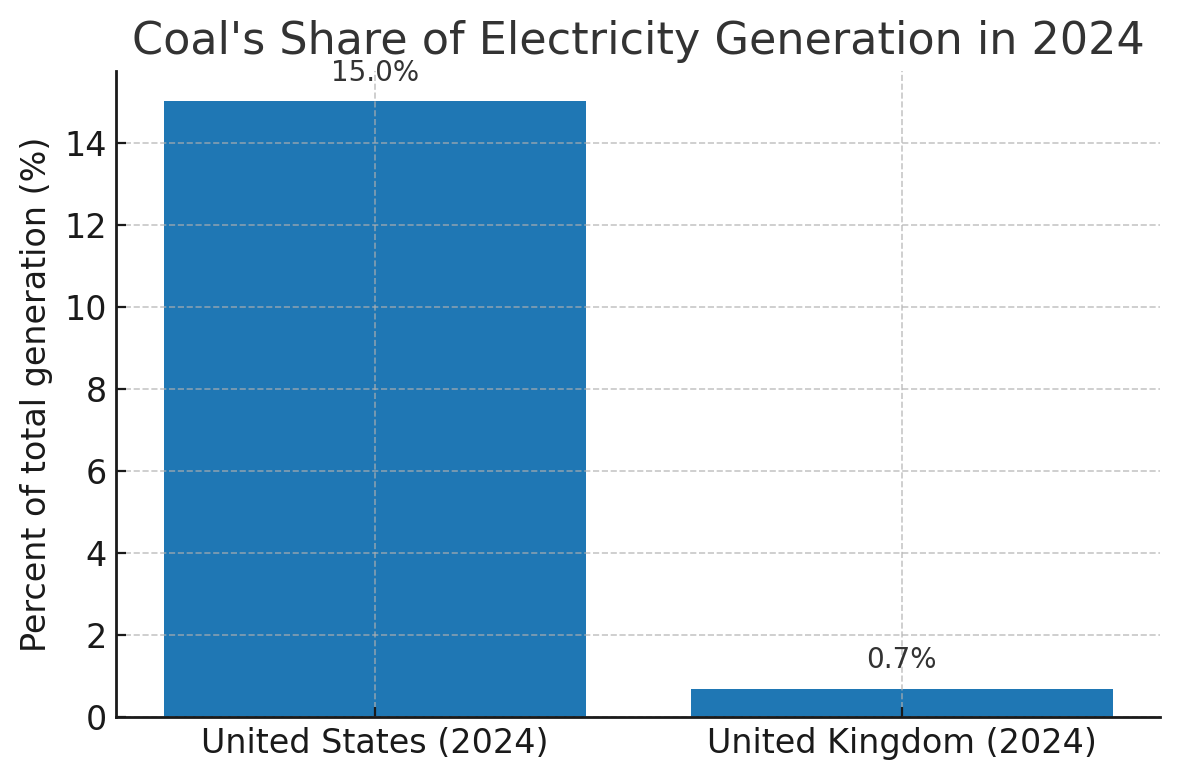
Coal share of electricity, 2024 • United Kingdom: 0.7% • United States: 15% The UK’s coal share fell under 1% in 2024, the first full year that ended with zero coal plants operating into 2025. In the U.S., coal still supplied about 15% of generation in 2024.
Coal production, then vs now (U.S.) • 2010: 1,085 million short tons • 2024: 512 million short tons (lowest since 1964) Even with declines, coal remains a sizable slice of U.S. generation, especially during peak demand.
Why the UK moved faster
Policy alignment: UK carbon pricing and clear phaseout commitments killed coal economics and created certainty for investors. Result: coal’s electricity share collapsed from nearly a third a decade ago to under 1% in 2024.
System transition: Renewables and nuclear now carry most of the load. DESNZ reports renewables hit 50.4% of UK generation in 2024, while fossil fuels fell to 31.8%.
Why the U.S. keeps wobbling
Short-term demand shocks: New AI and data center load, hot summers, and grid constraints nudge operators to pull familiar levers. EIA expects record U.S. power use in 2025 and 2026, with a temporary coal bump in 2025.
Patchwork policy: Without consistent federal signals, economics vary by region. Gas stays dominant in many markets, and coal lingers where plants are depreciated and transmission is tight.
The strategic read
If the UK’s demolition is a mirror, here’s what it reflects:
Momentum compounds. Clear policy and grid planning compress timelines. The UK reached near-zero coal while lifting renewables to a majority share in 2024.
Short-term coal upticks are a mirage. EIA’s 2025 blip does not change the U.S. downtrend in coal generation and production. Coal production dropped from 1,085 million short tons in 2010 to 512 million in 2024. The long arc still bends away from coal.
Talent follows direction. Clear roadmaps attract the engineers, developers, and builders who deliver reliable clean power at scale. Mixed signals slow projects and hiring.
My take
That record-setting boom in Nottinghamshire was more than demolition. It was a line in the sand. The UK is freeing up land, capital, and talent for the next grid. The U.S. can do the same. Set consistent policy. Build transmission. Accelerate storage and firm clean. Treat coal’s brief rebound as a grid-reliability patch, not a plan.
If your team is scaling clean energy, storage, or grid projects and you need leadership that can execute through this pivot, I’m here to help.
Sources for key facts
Record demolition at Cottam: EDF Energy press release; Brown & Mason announcement.
UK coal era ends: AP coverage of Ratcliffe closure.
UK 2024 generation mix and coal share: DUKES 2025.
U.S. 2024 coal share and context: Ember’s U.S. Electricity 2025 Special Report.
U.S. record demand and coal share outlook: Reuters summary of EIA.
U.S. coal production: EIA “Today in Energy” 2025 and 2010 Year in Review.